

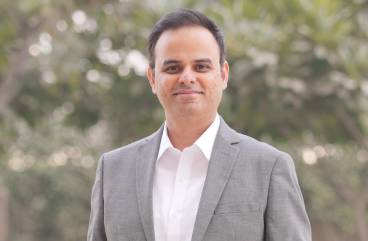
Vishal Lathwal
Chief Executive Officer, Apollo Home Healthcare Ltd.
PGPM ’12
Alumni Series #2
Bengaluru, 2010
During his early consulting years, Vishal Lathwal spent most working days constructing financial models and presentation decks. Although those assignments sharpened analytical discipline and exposed him to the movement of value through complex organisations, they also revealed a limitation: technical precision seldom guarantees lasting organisational change. Convinced that broader capability required systematic study, he enrolled in the PGPM programme at Great Lakes Institute of Management.
At twenty-three he was the youngest member of his cohort, surrounded by peers whose managerial experience often spanned a decade. Initial apprehension soon gave way to purposeful engagement. Faculty members, exacting yet supportive, insisted that context precede recommendation. Informal discussion, often extending late into the night, provided additional instruction on the practical constraints that govern executive decisions.
Upon graduation he departed consulting and joined an automotive manufacturer, following personal enthusiasm rather than calculated advantage. Soon afterwards he pivoted to healthcare, a field insufficiently celebrated in business-school corridors yet rich in complexity and public consequence. Over the next ten years he progressed through hospital administration, nursing services, and emergency response, designing care models able to scale without compromising quality.
Today, as Chief Executive Officer of Apollo Home Healthcare Ltd. - he directs one of Asia’s largest private providers toward service configurations that bring hospital-grade treatment into patients’ homes. The post demands coordination among clinicians, technologists, and community resources, and it obliges constant attention to the lived experience of patients and families.
Reflection has shaped his governing principle: professional standing follows sustained inquiry, not the reverse. He therefore counsels younger managers to preserve curiosity, to welcome discomfort as a sign of growth, and to judge every metric by its human implication.