Online Education vs Offline Education: Which is better?
Last updated on: 3rd October, 2026 | Analytics Insights | Nitin Verma, GM - Admissions & Marketing << back to blog
Published on: 3rd October, 2026
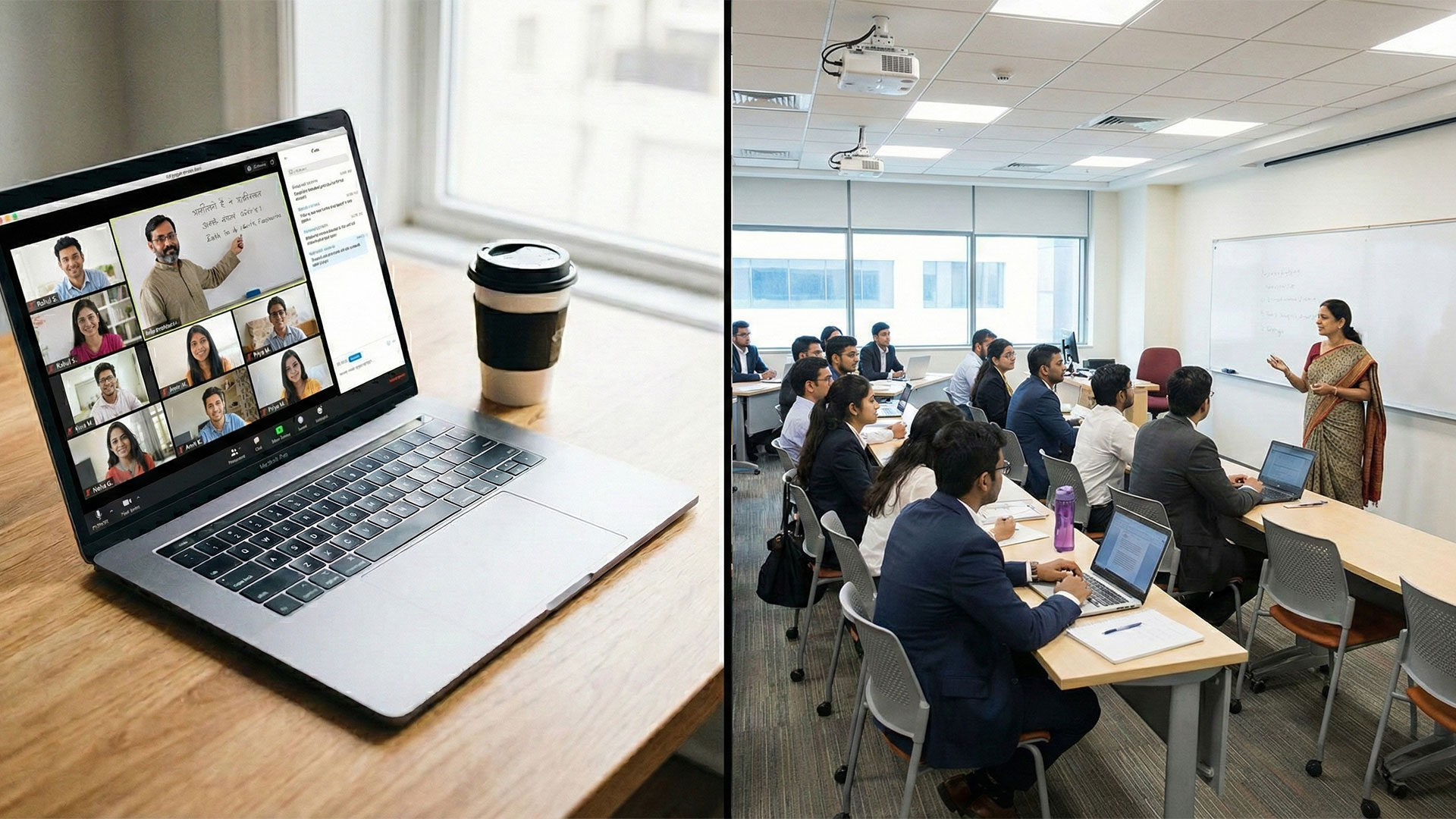
The COVID-19 pandemic accelerated a shift that had quietly begun decades earlier: the move from campus classrooms to screens and headsets. In the 1980s, only a few pioneers used the basic internet; today, a survey by Ani Petrosyan states that 67.9% of the world's total population is online. This connectivity powered a boom in virtual learning, with millions of students now choosing courses they can start, pause, or revisit on their schedule.
From college students to mid-career professionals, learner preferences are evolving with time. Some seek the structure of a brick-and-mortar campus, while others look for flexible schedules and global networking. As digital platforms mature and enrollment numbers climb, the debate "online education vs offline education" matters more than ever. So, scroll down to weigh the pros and cons of both learning models so you can pick the path that suits you best.
How Do Online and Offline Education Truly Compare Today?
While traditional learning systems rely on an offline classroom approach, modern education is seeing a shift towards online learning methods. A joint study by the Learning House, Inc. and Aslanian Market Research reveals that about 85% of students expressed that online learning is better than campus education. Yet another post-COVID study by Ms Ulfat Amin et al. shows that about 45.1% of students found offline learning to be more focused and reliable. This contradictory data raises the complexity of comparing the benefits of online format with offline education advantages.
In order to draw a fair comparison between the two, let us examine both the online education pros and cons alongside offline education in the table below:
| Aspect | Online Education | Offline Education | Conclusion |
| Flexibility and Accessibility | Self-paced modules fit into busy lives and work schedules. | Structured and strict schedule; Location-bound but offers routine and predictability | Online wins on convenience |
| Learning Environment and Discipline | Requires self-discipline; some students report boredom or tech distractions. | Classroom structure enforces attendance, accountability, and fewer distractions. | Offline builds a stronger habit |
| Cost Comparison | Generally lower tuition with zero travel or housing costs, but students lose the opportunity for peer interaction. | Higher fees when you factor in campus facilities, travel, accommodation, but richer peer networks | Online is more affordable, but comes with trade-offs |
| Interaction and Engagement | Forums, chats, and live sessions enable interaction, but lack spontaneous debate. | Peer interaction through live debates, group projects, in-person cues and relationships. | Offline offers direct human connection |
| Technology and Innovation | Uses Learning Management System (LMS) for instant analytics, Augmented Reality (AR) and Virtual Reality (VR) to personalise learning. | Relies on classroom tech; hands-on labs for sciences or vocational skills, but fewer digital innovations. | Online leads in tools and real-time feedback |
What Are the Pros and Cons of Online and Offline Education?
Students often face the dilemma of choosing the learning format that best suits their academic needs, lifestyle, and career goals. To make an informed decision, it becomes important to understand the pros and cons of online education vs offline education.
Let us have a detailed look at what features make these learning formats stand out and their trade-offs:
Online Education Pros: Flexible, Scalable, Cost-Effective, Ideal for Professionals
One of the top advantages of online education is the flexibility it offers through its self-paced modules. All you need is an internet connection and a compatible device to watch online lectures anytime and anywhere. These online courses are scalable, as you get access to interactive live sessions with global academic leaders.
For example, a student from a small town can learn from professors of an international university from the comfort of their own home. Similarly, a working professional can obtain business insights through industrial experts, learning new skills while working full-time.
This learning format is cost-effective as it eliminates the additional expense of travel, housing, and physical study materials (most online modules are digital). Online programs make quality education accessible to students who cannot afford traditional college degrees, democratising the learning for people from diverse financial backgrounds.
Online Education Cons: Limited peer interaction, Screen fatigue, Self-discipline required
While online learning offers many advantages for working professionals seeking self-paced and skills-based education, it also has several limitations you should consider. It is appropriate for mature students who have virtues of self-discipline and are accountable towards their academics. However, most learners often need the extra push that regular offline classes provide to maintain consistent learning habits. Adding to this, digital distraction may hinder a student's focus and overall learning progress.
Online classes often require learners to use their device's screen for long periods. This extended exposure may cause screen fatigue with symptoms like headaches, eye strain, and weariness. Another disadvantage is the limited interaction with peers, which deprives online learners of healthy discussions and building long-term professional networks. While this format offers discussion groups and forums for collaboration, these fail to replace the spontaneity of face-to-face conversations.
Offline Education Advantages: Structured schedules, peer engagement, physical presence
Offline education advantages include a structured class schedule and a strict curriculum that helps students build disciplined study habits. They have to attend classes physically, where their faculty track their learning progress, holding them accountable towards their academic commitments. This provides them with an external push and direction that helps them reach their desired learning goals.
Traditional classrooms help students engage with peers, where they engage in collaborative group activities and conduct healthy discussions. They build long-term academic relationships with classmates that further help in their prospective careers.
The real-time interaction with faculty and peers lets learners get familiar with diverse perspectives and clear any academic doubts instantly. Classroom learning is supported by modern labs and academic resources that give students access to hands-on training that online courses fail to offer.
Disadvantages of Offline Education: Higher cost, time constraints, location dependence
One of the biggest disadvantages of offline education is its high cost due to its expensive tuition and fees, along with the financial burden of daily commute and housing. Additionally, large class size limits the individual focus that a student requires. The strict academic schedule in offline education means that most adult learners may have to compromise their professional and personal responsibilities.
Geographic constraints of offline classes add another layer of academic barriers for students who may not possess adequate financial resources to relocate to a new place. This will further require them to disrupt their personal and professional lives, which is not possible in most cases. Additionally, the offline modules often prove rigid as they do not cater to the diverse learning needs of students.
Which Mode of Learning Is Better for Different Types of Learners?
Now that you understand the pros and cons of online education versus offline education, which format is best for you depends on your learning needs. Both formats aim to develop essential technical and soft skills in students. However, to help you decide which one aligns with your career stage and professional goals, let's look at the following points:
Online Education for Working Professionals, Career Switchers, and Entrepreneurs
The flexibility and individual attention that online education offers work best for working professionals, career switchers, and entrepreneurs. It gives them the freedom to continue learning and reskilling while juggling their professional, family, and other responsibilities. These e-learning programs come with asynchronous classes that help you build your job-specific skills. For career transitioners, it helps them reskill without leaving their current profession, while entrepreneurs can upskill side by side with their demanding schedules.
Take the Great Lakes Institute of Management's executive MBA courses, for example. Their online programs in Analytics, Product Management, and AI-ML are designed keeping working professionals in mind. These programs focus on job-specific skills that let you learn while maintaining your current income.
Offline Education for Full-Time Students, Fresh Graduates, and Research Aspirants
For fresh graduates and full-time students, traditional offline and institutional education remains the most effective academic approach. These programs provide dedicated physical learning spaces with facilities such as labs and libraries, offering research resources that online courses do not include. Offline degree programs follow a fixed academic schedule, which helps young learners develop consistent study habits.
Students also enjoy campus life, engaging with peers from diverse backgrounds. This broadens their learning experience, as they participate in group discussions and build meaningful networks that support them throughout their academic journey.
Hybrid Learning Models Are Emerging as the Best of Both Worlds
Combining the benefits of both online and offline education, hybrid learning models are growing in popularity. Great Lakes Institute of Management's Post Graduate Executive Program in Management (PGXPM) and other online MBA courses, for example, provides the flexibility of online courses with theoretical lectures that you can complete at your own pace. Additionally, it includes campus residencies, which allow you to gain practical skills through workshops, networking sessions with experts, and collaborative group projects.
Hybrid programs like the Post Graduate Program in Management (PGPM) work best for mid-career professionals as they accommodate their demanding schedules while providing access to quality education. They also remove the dilemma of online education vs offline education among students, so they can focus on their academic goals with clarity. With the introduction of technologies like Virtual Reality (VR) and Artificial Intelligence (AI) that offer immersive and personalised learning, hybrid learning has become even more effective today.
"Also Read" How to Choose the Right Online MBA Course Based on Your Career Goals?
Choose The Right Mode of Education Based on Your Needs
This detailed comparison between online education vs offline education leads to a simple conclusion: no learning format is universally "better". Both models aim to provide quality education to students. However, which one is the best fit for you depends entirely on your future aspirations, career stage, age, and lifestyle.
Today, online education is becoming increasingly popular due to its job-specific and skills-based focus that aligns with the academic needs of working professionals. These flexible programs, when delivered by a credible and accredited institution, allow learners to overcome career plateaus, increasing their chances of promotion and salary hikes.
Want to scale your career with skills-specific and flexible online programs? Explore high-impact professional courses like the PGXPM, PGPM, and Post Graduate Diploma In Management (PGDM) today!