MBA Application Tips to Consider Before Applying: Do’s & Don’ts
Last updated on: 25th September, 2026 | Admissions | Gaurav Chabra: Manager - Admissions << back to blog
Published on: 25th September, 2026
Summary Points:
- 78% for MBA grads vs ~54.8% national average, making top B-schools a high-stakes, high-return bet.
- GMAC reports a 26% jump in applications to Indian business schools in 2025, as standing out now needs more than a strong profile.
- Clear goals + authentic SOP + sharp interview prep are what differentiate PGPM/PGDM/EMBA/1-year MBA applicants.
- Tailoring, proofreading, deadlines, and accreditation checks can be the difference between shortlisting and rejection.
In India’s vibrant management-education scene, competition for seats at the top MBA colleges is at an all-time high. According to the 2025 data from the India Today report, MBA graduates now lead in employability with a rate of 78 % compared to the national average of ~54.8 %.
This means that the value of an MBA credential remains strong, and the stakes for admission are only rising. So your application must stand out not just in terms of profile, but in clarity, fit, and authenticity.
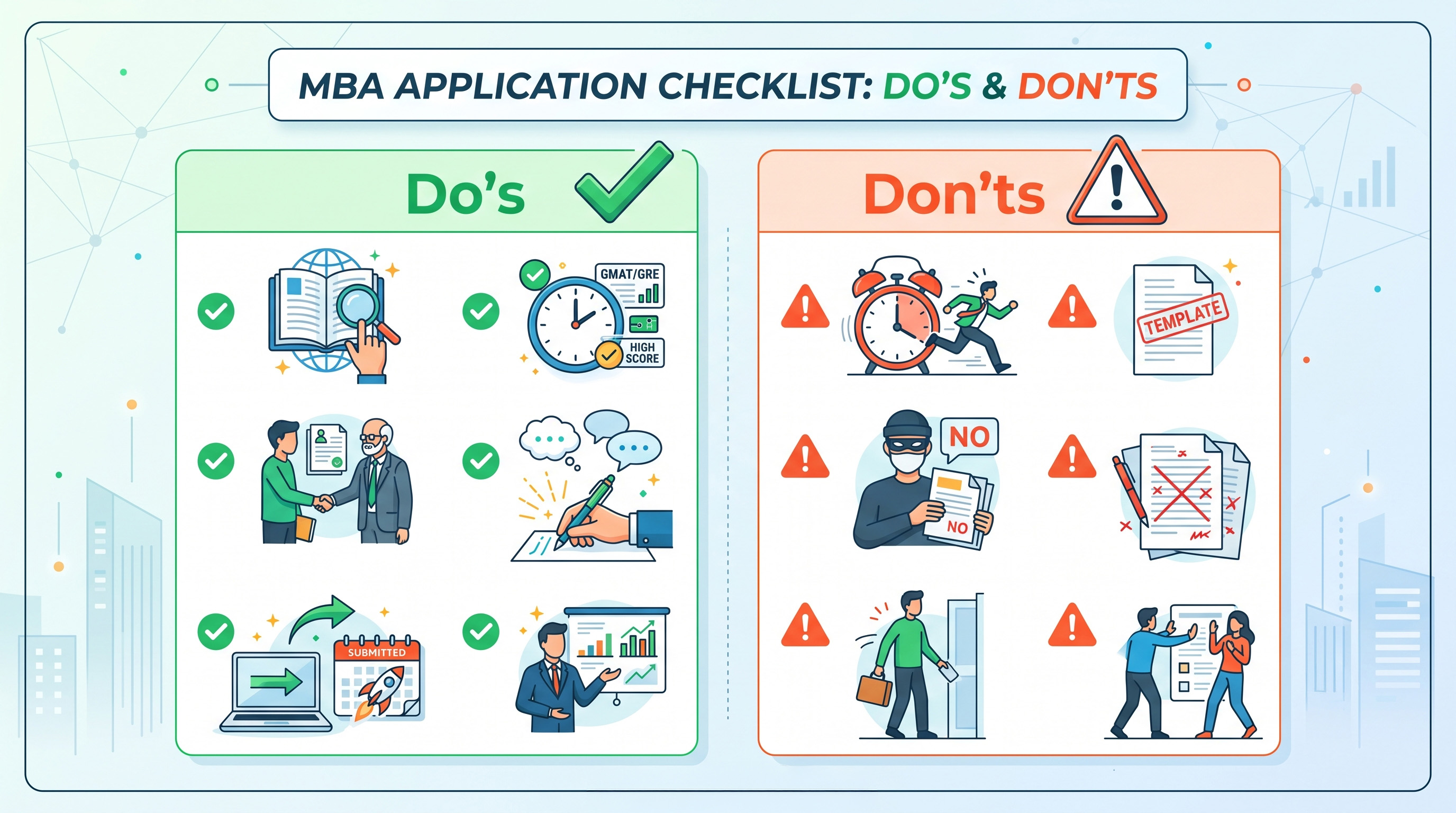
Here’s a comprehensive guide of MBA application do’s and don’ts to help you secure a place in one of the best MBA colleges in India.
How to Strengthen Your MBA Application in 2025
Getting into a leading business school takes more than good grades or work experience, it’s about showing clarity, purpose, and genuine fit. Whether you’re applying for a PGPM, PGDM, or Executive MBA, your application should reflect both direction and depth. At Great Lakes Institute of Management, we’ve seen how thoughtful preparation can turn strong professionals into standout applicants ready for global leadership.
Do #1: Define Clear Career Goals
Do: Take time to clarify your short-term and long-term career objectives. Are you aiming for a leadership role in strategy, shifting industry, or launching your own venture? The admissions team at leading schools looks for candidates who articulate why they need an MBA now and how it fits their professional trajectory. Schools offering PGDM or Executive MBA formats often prioritise professionals who have already delivered business results and aim to scale up.
Don’t: Apply without direction or say “I want to be a leader” in vague terms. Generic goals dilute your application. Without clear alignment, the admissions committee may doubt whether you’re ready or whether the program matches your needs.
Do #2: Research and Select the Right program
Choosing between a PGPM, PGDM, Executive MBA or one-year MBA in India demands careful thought.
Do: Match the program type to your profile.
- If you have ~3–5 years’ experience and want a faster career switch, a one-year MBA in India might suit you.
- If you have ~5–15 years of experience and want to continue working while studying, an Executive MBA is appropriate.
- If you prefer a full-time residential format or are early in your career, a PGPM or PGDM works.
Also evaluate: curriculum, industry interface, alumni network, format (weekend vs full-time), and reputation. Institutions ranked among the best colleges in Chennai and elsewhere offer differentiated options tailored to working professionals or fresh graduates.
Don’t: Choose solely based on rankings or peer counts. Select a program just because it’s “top-ranked” without checking whether it aligns with your goals. Also avoid picking formats that require leaving work if you are not ready to pause your career.
"Also Read" How to Choose the Right MBA Program Based on Your Experience Level?
Do #3: Write a Strong and Authentic SOP
Your Statement of Purpose (SOP) is one of the most important parts of your application , it tells your story.
Do: Structure your SOP with three key sections:
- Motivation: What led you to consider business management?
- Achievements & Learning: What have you done so far that shows leadership, impact or potential?
- Why this program/institution: How will this specific school (PGPM/PGDM/Executive MBA) help you reach your goals?
Mentioning features of the institution you’re applying to (faculty strengths, international exposure, cohort diversity) shows you’ve done your homework. This is especially important when applying to reputed institutions recognised among the best MBA colleges in India.
Don’t: Use generic phrases like “I want to become a leader” or reuse the exact same essay across schools. Admissions committees will spot repetition and lack of personal insight. Avoid clichés or vague statements: “Management is my passion.” Instead, refer to specific experiences and learning.
Do #4: Prepare Smartly for the Interview
If your application is shortlisted, the interview is where your personality, clarity and fit come alive.
Do:
- Research the school’s mission, recent initiatives, curriculum focus and alumni outcomes.
- Be prepared to discuss your career goals, biggest professional challenge, leadership experience, and how you’ll contribute to the cohort.
- Prepare thoughtful questions for your interviewer that show genuine interest, such as asking about a recent leadership lab or global immersion offered in their Executive MBA or PGPM program.
- Practice articulating your “why” for choosing this program, whether PGDM/PGPM or even a one-year MBA in India format.
Don’t: Memorise scripted answers and sound robotic. Avoid appearing overconfident or underprepared. Don’t neglect the basic dress code, body language or punctuality. These reflect professionalism.
Do #5: Check Accreditation and Reputation
A reputed institution adds credibility to your qualification.
Do: Ensure the school you apply to is accredited (for example, by AICTE, NBA, AMBA) and has a solid track record of placements and industry interface. Schools listed among the best MBA colleges in India often provide data on outcomes, ROI and recruiter visits. If you’re applying to a school in Chennai (or seeking the best colleges in Chennai), check for local industry connections as well as global exposure.
Don’t: Enrol in institutions that have weak placement records or minimal industry collaboration. Avoid being swayed solely by low fees or easy entrance. Accreditation and reputation matter when you’re seeking roles from the global market.
Do #6: Avoid Common Application Mistakes
Even strong candidates can falter due to avoidable errors.
Do:
- Proofread your application multiple times for grammar, clarity and consistency.
- Upload all required documents in the correct format and before deadlines.
- Use a professional email and clear, concise resumes tailored to your MBA application.
- Apply early in the admission window; many programs fill seats or distribute scholarships early.
Don’t:
- Apply to multiple schools with the same essay or resume without tailoring.
- Miss deadlines or send incomplete forms.
- Ignore the profile details section; inconsistencies between the resume, SOP and employment records raise red flags.
- Assuming your work experience alone ensures admission, the committee evaluates fit, potential and maturity too.
Do #7: Demonstrate Fit with the Institution
Cultural and academic fit matter significantly.
Do: Research the institution’s values, teaching philosophy, cohort characteristics and format (whether PGPM, PGDM, Executive MBA or one-year MBA in India). Mention these in your SOP or interview: for example, “I admire the school’s leadership lab because it fits my current aspiration to lead cross-functional teams.” If you’re considering a school among the best colleges in Chennai, highlight how its regional industry ecosystem aligns with your plans.
Don’t: Treat every MBA program as identical. Avoid saying “I will contribute to your brand” without demonstrating how you contribute specifically to this school’s culture. Lack of fit is a common reason for rejection.
Do #8: Seek Guidance and Feedback
Even the strongest candidates benefit from mentoring and review.
Do: Reach out to current students or alumni of your target programs (whether PGPM, PGDM, Executive MBA). Ask for their experience, tips on SOPs, interview insights and school culture. Use professional review services, mentors or mock interviews.
Don’t: Ignore feedback or submit the first draft of your application as is. Rewriting and refining based on feedback can significantly improve your chances. Also, avoid relying solely on peer groups who may not have experience with admissions processes.
Align Your Goals With the Right B-School
The MBA journey begins long before the classroom; it starts with the application process. A strong application reflects your professional achievements, your clarity of purpose, self-awareness, and commitment to personal growth. Whether you aspire to join a one-year MBA in India, a PGPM, or a PGDM, the key is alignment between your goals, the program’s strengths, and the institution’s values.
Institutions like Great Lakes Institute of Management, one of the best colleges in Chennai, have designed programs that prepare future leaders for the complexities of modern business. From leadership development to global exposure, Great Lakes ensures every student is empowered to create impact. So before you click that “Apply” button, take a moment to reflect, research, and prepare. When your goals align with the right B-school, your MBA journey can become a life-changing experience.